Beyond Efficiency: How Industrial Robots Strengthen Production Stability
Industrial Robots for Stable, Predictable, and Scalable Manufacturing
In modern manufacturing, the pursuit of efficiency often takes center stage—but many factories overlook a more critical driver of long-term profitability: production stability. While industrial robots are widely recognized for boosting output rates, their greatest value lies in stabilizing workflows, reducing variability, and ensuring predictable operations.
This article explains how industrial robots improve production stability beyond efficiency, why stability matters more than speed for scalable manufacturing, and how factory robots help companies build reliable, low-risk production systems.
I. Production Stability vs. Efficiency in Manufacturing Automation
Before evaluating the role of industrial robots, it is essential to clarify the difference between efficiency and production stability—two metrics that are often confused but fundamentally different.
What Is Production Stability in Manufacturing?
Production stability refers to a factory’s ability to maintain:
Consistent output over time;
Predictable cycle times;
Uniform product quality;
Minimal unplanned downtime.
Stable production allows manufacturers to plan accurately, deliver reliably, and control long-term operational risks.
Why Efficiency Alone Is Not Enough for Long-Term Manufacturing Success
Efficiency measures how fast production occurs. However, efficiency gains often reach a ceiling. Instability—caused by labor turnover, human error, quality variation, or equipment failure—continues to erode capacity and profitability over time.
Manufacturing robots address this gap by embedding consistency into core processes, transforming short-term efficiency gains into sustainable productivity.
II. How Industrial Robots Improve Production Stability
Industrial robots do not simply accelerate production; they standardize and stabilize it. Below are the key mechanisms through which factory robots improve long-term production stability.
Eliminating Labor Variability with Industrial Robots
Labor variability is one of the biggest threats to production stability. Fatigue, skill differences, absenteeism, and employee turnover all introduce inconsistency into output and quality.
By automating repetitive and labor-intensive tasks, manufacturing robots eliminate these fluctuations. Factory robots operate continuously with the same precision, regardless of shift schedules or workforce availability. This allows manufacturers to maintain stable output 24/7—even in environments facing labor shortages.
Ensuring Process Consistency and Reducing Quality Variation
Quality fluctuations often trigger rework, scrap, and unplanned downtime. Industrial robots deliver repeatability as tight as ±0.02 mm, ensuring every unit is produced according to the same parameters.
By automating critical processes such as welding, precision assembly, and coating, robots eliminate errors caused by fatigue or inconsistent technique. This reduces defect rates, minimizes rework, and keeps production flows uninterrupted—particularly important in industries like automotive, electronics, and metal fabrication.
Maintaining Stability in Flexible and High-Mix Production
Market demand increasingly favors small-batch and customized production, which traditionally sacrifices stability. Industrial robots solve this challenge through rapid reprogramming and tooling changes.
Unlike manual production lines that require extensive reconfiguration, factory robots can switch tasks quickly while maintaining consistent quality and cycle times. This enables manufacturers to adopt flexible manufacturing models without compromising production stability or delivery reliability.
Standardizing Manufacturing Processes and Minimizing Human Intervention
Human intervention, even by skilled operators, introduces variability. Manufacturing robots convert best practices into programmable workflows, ensuring each product follows standardized steps.
By minimizing manual adjustments, industrial robots reduce the risk of process deviations, safety incidents, and operational errors—creating a predictable, low-risk production environment.
III. Industry Examples: Production Stability in Action
Automotive Manufacturing: Stable Welding and Assembly Lines
A global automotive plant replaced manual welding with industrial robots for chassis assembly. The result was not only faster output, but also a 40% reduction in welding defects and a 25% decrease in unplanned downtime.
Factory robots eliminated technique-related variability, ensuring stable production schedules and consistent quality.
3C Electronics Manufacturing: Stability in High-Mix Production
A 3C manufacturer producing smartphone components deployed manufacturing robots for high-precision component insertion. Despite frequent model changes and small-batch orders, the robots maintained stable capacity and quality. Defect rates dropped by 35%, while on-time delivery improved from 82% to 98%.
Metal Fabrication: Reducing Workers Errors and Equipment Collisions
A metal fabrication shop automated CNC machine tending and material handling using industrial robots. Previously, fatigue-related errors caused frequent collisions and downtime. After automation, unplanned downtime fell by 30%, and throughput remained consistent across all shifts.
IV. Practical Strategies to Build Production Stability with Industrial Robots
Select Industrial Robots Based on Stability, Not Just Speed
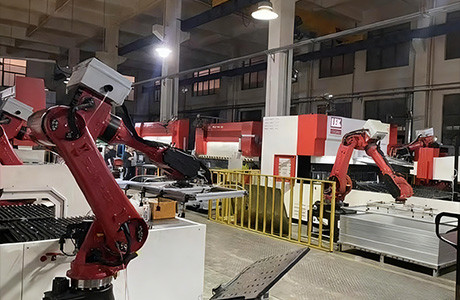
When choosing manufacturing robots, prioritize repeatability, reliability, and system compatibility. For example, six-axis robots offer high process consistency for complex tasks, while collaborative robots enhance stability in mixed human-robot workcells.
Stabilize Processes Before Automation
Automation should reinforce stable processes—not replicate unstable ones. Mapping and optimizing workflows before deploying factory robots ensures automation amplifies consistency rather than inefficiency.
Use Production Data to Continuously Improve Stability
Integrating industrial robots with smart factory systems enables continuous monitoring, predictive maintenance, and data-driven optimization—turning reactive fixes into proactive stability improvements.
V. Common Misconceptions About Industrial Robots and Stability
Misconception 1: Robots only improve efficiency, not stability
Industrial robots’ greatest long-term value lies in consistency, not speed.
Misconception 2: Only expensive robots deliver stability
Stability depends on proper matching between robots and processes, not price.
Misconception 3: More robots always mean more stability
Over-automation increases complexity. Targeted automation delivers better results.
Conclusion: Production Stability Is the Real Advantage of Industrial Robots
Manufacturing robots are not merely efficiency tools—they are stability enablers.
By eliminating labor variability, ensuring process consistency, reducing downtime, and enabling flexible yet predictable production, robots transform unstable workflows into scalable manufacturing systems.
Working with an experienced robot application partner can help align automation decisions with real production conditions, budgets, and stability objectives—laying the foundation for reliable, sustainable growth.