How to Implement Robotic Welding Without Creating a New Bottleneck
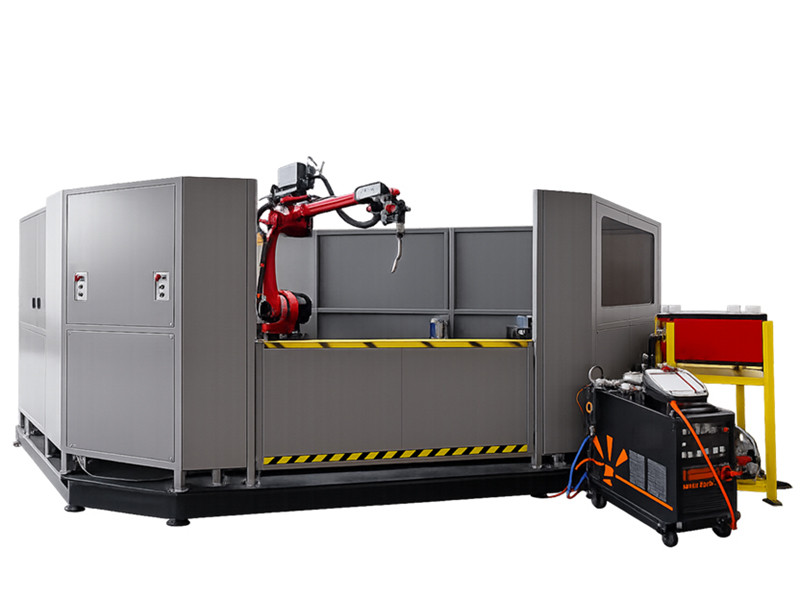
A robotic welding project can solve one production constraint and still create another.
The robot may reduce direct welding time, yet the cell can underperform because fixtures are inconsistent, changeovers are slow, operators cannot recover from routine faults, or upstream fabrication cannot supply parts at the required rate.
That is why robotic welding implementation should be treated as a production-system project rather than an equipment installation.
A useful sequence is:
select the right application → stabilize the process → define acceptance metrics → build internal operating capability
The goal is not simply to make the robot weld.
It is to create a process that can produce acceptable parts at the expected rate without becoming dependent on constant engineering intervention.
Start With the Right Part
The first robotic welding application should not necessarily be the part with the highest labor content, the largest weld, or the most difficult geometry.
A strong pilot application is one where the shop can clearly determine whether automation is working.
Good first parts usually have several characteristics.
The geometry is repeatable. Joint locations, gaps, and component dimensions remain within a reasonably controlled range from one assembly to the next.
Demand is stable enough to reuse the setup. The fixture and program will run often enough that engineering effort can be spread across meaningful production volume.
The fixture requirement is manageable. The part has usable locating features, can be clamped consistently, and does not require an unusually complex tooling concept simply to establish joint position.
The welds are accessible. Torch angles, robot reach, clearance, and part positioning can be achieved without forcing the first project into unnecessary mechanical complexity.
The welding process is already understood. The team knows which process, parameters, joint preparation, and sequence can produce acceptable welds manually or in controlled trials.
Current performance can be measured. Existing cycle time, labor hours, defect levels, and rework provide a baseline against which the automated process can later be evaluated.
There is enough meaningful weld or labor content to automate. A technically easy part with only a few seconds of welding may be a poor economic pilot if automation removes very little work.
Taken together, the ideal first application is not simply “easy.”
It is repeatable enough to control, valuable enough to matter, and measurable enough to evaluate objectively.
One common mistake is selecting the most difficult weld in the plant because management wants the first robot to demonstrate maximum technical capability.
That can introduce several unknowns simultaneously: difficult access, unstable fit-up, complex fixtures, sensing requirements, distortion, unfamiliar programming, and uncertain welding parameters.
If the project struggles, it then becomes difficult to determine whether the limitation is the robot, fixture, part, process, or application choice.
A better first application gives the team a controlled environment in which to build experience and establish a repeatable deployment method.
A robot-ready part assessment can help identify that starting point before cell architecture is selected.
Validate Fixtures and Weld Parameters First
Automation is most effective when it reproduces a process that is already understood.
It is much less effective when the project attempts to use robot programming to compensate for unresolved production instability.
A useful implementation principle is:
Automation magnifies process repeatability; it does not automatically fix process instability.
Before finalizing the automated process, validate the conditions that determine whether the programmed path and welding parameters will remain usable.
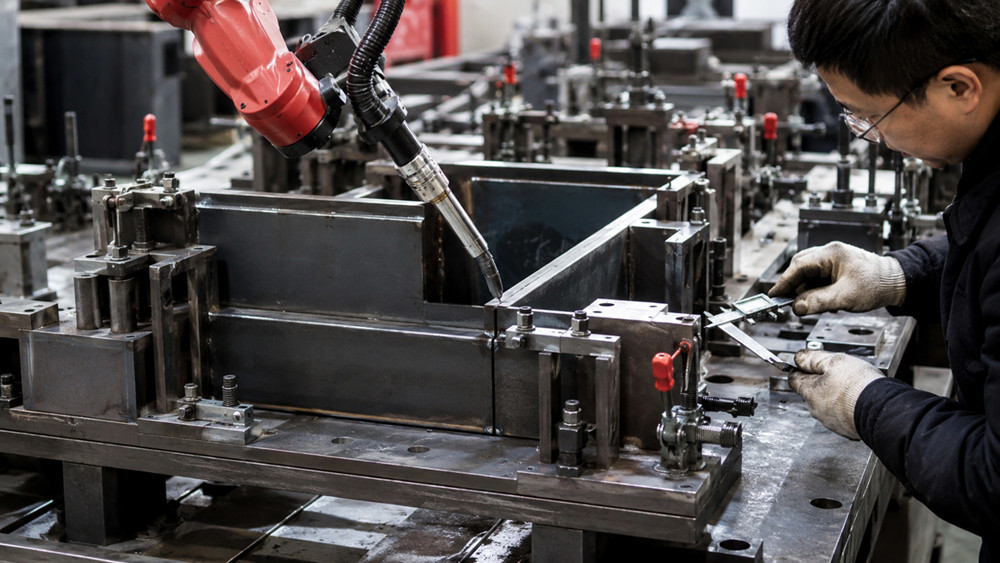
Confirm Fit-Up and Gap Behavior
Review actual production parts rather than only drawings or ideal samples.
Measure how joint gaps, mismatch, component position, and tack conditions vary across normal production.
The key question is not whether every part is identical.
It is whether the variation remains within a range that the fixture, weld process, and any planned sensing can handle consistently.
If existing fit-up varies beyond that range, the project may require upstream process changes before robot programming begins.
Establish Repeatable Locating
Determine which part features should define the fixture datums and verify that those features themselves are stable.
A fixture cannot create consistent joint location if it references geometry that moves significantly between parts.
Locating strategy should therefore be validated against real dimensional variation, not just nominal CAD geometry.
Validate the Clamp Strategy
Clamps must hold the components in the intended relationship without blocking the torch or making loading unnecessarily slow.
They should also maintain fit-up throughout the weld sequence where required.
If the part repeatedly moves when clamps engage, heats during welding, or is released, those behaviors should be understood before they are embedded into an automated production cycle.
Confirm the Weld Sequence
The order of welds can affect distortion, accessibility, fixture loading, and the location of later joints.
A sequence that works acceptably for a skilled manual welder may need to be reconsidered for automation because the robot will reproduce the sequence exactly as programmed.
Validate whether earlier welds move later joints and whether the fixture can maintain the required geometry throughout the cycle.
Establish Stable Process Parameters
The automated process also needs a known welding window.
Travel speed, wire feed, voltage-related settings, torch angle, stick-out, weave behavior, starts, stops, and other relevant parameters should be established for the expected production joint conditions.
The goal is not to find one parameter set that works on a perfect sample.
It is to understand whether the process remains acceptable across the normal range of production variation.
A frequent implementation mistake is buying the robot first and discovering later that the parts cannot be located or welded consistently enough to support a fixed program.
At that point, the company may need unplanned fixture redesign, sensing, upstream process improvements, or additional integration work.
Stabilizing the process before committing to the final cell configuration makes those requirements visible earlier, when they are less expensive to address.
Define Acceptance Metrics Before Buying
A welding automation project should have measurable success criteria before a purchase order is issued.
Otherwise, the integrator may successfully deliver a robot that welds the part while the manufacturer later discovers that the cell does not meet the operational or financial objective that justified the investment.
The basic structure should be:
Current manual baseline → agreed automated target → acceptance method
Several metrics are particularly useful.
Cycle Time
Measure the existing total cycle, not only manual arc-on time.
The automated target should define what is included: loading, clamping, welding, positioner motion, inspection, unloading, and any other recurring activity.
This prevents a technically fast robot program from being accepted even though total cell output misses the production requirement.
Throughput
Cycle time is a process metric; throughput is an output metric.
Define how many acceptable parts the system is expected to produce over the relevant shift or production period.
Throughput targets should account for the actual operating pattern rather than assuming continuous ideal production.
First-Pass Yield
If quality improvement is part of the business case, establish the existing first-pass yield and define what the automated process is expected to achieve.
This makes it possible to distinguish between faster production and more productive production.
A cell that makes defective parts faster has not delivered the intended output.
Defect and Rework Rate
Define which defects are currently significant and how they will be measured after automation.
Rework hours are useful in addition to defect counts because two defects can have very different economic consequences.
A minor touch-up and a part requiring extensive grinding and rewelding should not automatically carry the same cost in the ROI model.
Weld Quality Requirements
Acceptance criteria should be defined using the actual quality requirements of the product and welding procedure.
That may include dimensional requirements, weld size, location, appearance criteria, inspection results, or other applicable acceptance standards.
The important point is that “good weld quality” is not specific enough for a project acceptance test.
Uptime
Define what cell availability or uptime means in the context of the project.
The measurement should distinguish between normal planned activity and failures that prevent production.
Without an agreed definition, vendors and manufacturers may calculate uptime differently and reach very different conclusions about performance.
Planned vs Unplanned Downtime
It is useful to separate time intentionally spent on maintenance, changeover, or scheduled service from unplanned stops caused by faults or failures.
This gives the team a better view of whether lost production is inherent to the production model or caused by technical instability.
Changeover Time
For multi-SKU applications, changeover should be an acceptance metric rather than an assumption.
Measure the complete transition:
last acceptable part of SKU A → fixture/program/setup change → first acceptable part of SKU B
This captures the real production loss better than timing only the physical fixture swap.
Operator Labor Hours per Part
If labor reduction supports the ROI, baseline current labor content and define the expected labor requirement after automation.
Include loading, unloading, routine inspection, consumable changes, and other recurring work that remains in the automated process.
This prevents the financial model from assuming labor disappears when it has actually shifted to another part of the cell.
The reason these metrics must be established before purchasing is that they affect three things simultaneously.
First, they define the integrator scope. A requirement to achieve a specific changeover time or first-pass yield may influence fixture design, sensing, controls, and validation work.
Second, they define the acceptance test. Both sides know how successful commissioning will be measured.
Third, they protect the ROI calculation. The assumptions used to approve the project can later be compared with measured production results.
Without a baseline, the company may know that the cell is running but still be unable to prove whether the investment delivered the intended improvement.
A Robotic Welding Project Requirements Checklist can formalize these targets before quotations are compared.
Plan Training, Maintenance and Expansion
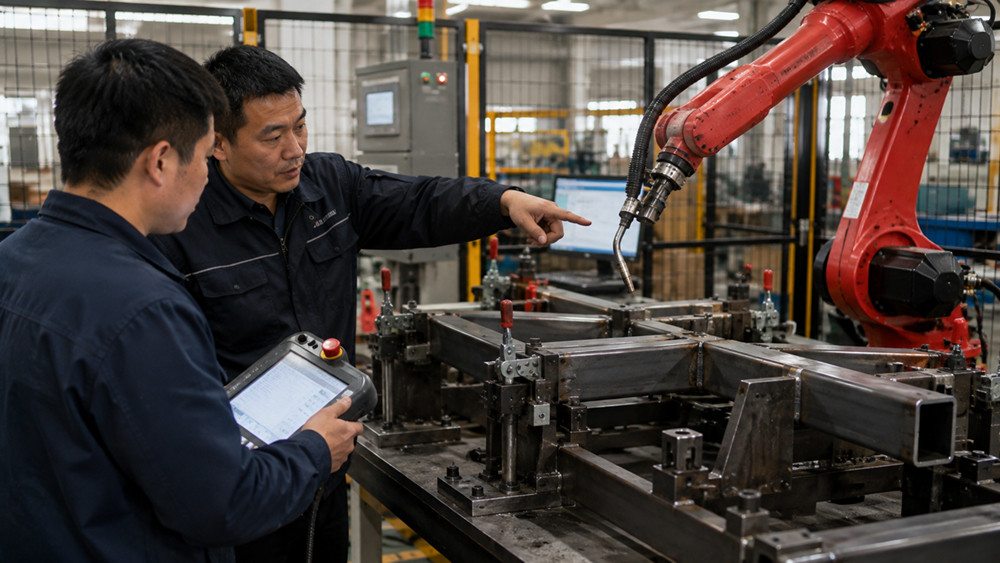
Commissioning is not the end of a robotic welding project.
The more important operational question is:
What must the plant be able to do after the integrator leaves?
A system that performs well only when external specialists are present can become difficult to operate once routine production variation begins.
Define Training Ownership
Different employees may need different levels of capability.
At minimum, the operation should identify who can:
restart the cell after routine stops;
load and select the correct job;
change welding consumables;
inspect the resulting weld;
identify common fault conditions;
adjust or teach approved robot points;
verify or restore TCP calibration;
recognize fixture-related problems; and
escalate welding-process issues correctly.
Not every operator needs advanced robot-programming access.
But someone inside the organization should understand enough of the system to distinguish between common failure modes.
For example:
Poor weld profile → inspect process conditions and welding parameters
Consistent path offset → inspect program, TCP, or coordinate references
Part-to-part path variation → inspect locating, fixture condition, or upstream fabrication
That diagnostic ownership reduces unnecessary downtime and avoids treating every problem as a robot-programming issue.
Assign Maintenance Responsibilities
The plant should also know who owns each layer of the cell.
Routine torch maintenance may belong to production technicians.
Fixture inspection may belong to manufacturing or tooling personnel.
Robot and positioner maintenance may require a dedicated maintenance team or qualified external support.
Calibration procedures need defined responsibility.
Critical spare parts should be identified according to likely failure impact rather than only purchase cost.
A relatively inexpensive component can create significant downtime if the plant has no replacement available and production depends on it.
Maintenance planning should therefore address:
torch + fixtures + calibration + sensors + robot + positioners + safety system + critical spares
The exact ownership model can differ by facility, but leaving those responsibilities undefined creates avoidable dependence on emergency support.
Plan for New SKUs
The first cell should also be designed around the realistic expectation that production will change.
That does not require predicting every future product.
It means avoiding architectural choices that make every new job equivalent to a new automation project.
Useful considerations can include:
a consistent fixture-datum strategy;
modular or replaceable fixture sections;
structured program naming and organization;
reusable welding routines;
capacity for additional programs;
spare control I/O where future devices are plausible;
provisions for sensing if future parts may require it;
and physical allowance for new fixtures or positioners where justified.
The objective is practical:
A new product should require a controlled extension of the existing system when possible, rather than forcing the team to rebuild the automation logic from the beginning.
Decide How Expansion Will Work
If the first application succeeds, the next question may be whether to add more SKUs, another fixture, seam tracking, a positioner, a second robot, or another complete cell.
That expansion is easier when the original project creates reusable standards.
For example, standardized fixture interfaces can make new tooling easier to introduce. Consistent program structures make troubleshooting and technician training more transferable. Documented acceptance metrics make it easier to compare the second project with the first.
This is where the first implementation creates value beyond its own production output.
It establishes a repeatable method for evaluating and deploying subsequent automation.
An application review or automation assessment should therefore consider not only whether the first part can be welded robotically, but also what operating capability the company will need to support that system over its production life.
By this stage, the decision should no longer be framed as simply robotic welding vs manual welding.
The more useful conclusion is that different production conditions call for different operating models:
stable, highly reusable work can support dedicated automation; recurring but changing work may support flexible automation; unpredictable and one-off work often continues to favor skilled manual welding.
Successful implementation begins when the chosen architecture matches those conditions—and when the production system around the robot is prepared to support it.
Send us your part & production requirements to get tailored workcell suggestions and quotations.