What Changes Occur in a Factory After Industrial Robots Run Continuously for Three Years?
Introduction
When manufacturers first adopt industrial robots, the focus is often on initial ROI and short-term efficiency. However, according to long-term project observations by RBRC and reports from the International Federation of Robotics (IFR 2025), continuous operation over three years reveals deeper transformations that directly impact sustainability, production stability, and workforce optimization.
1. Significant Improvement in Production Stability
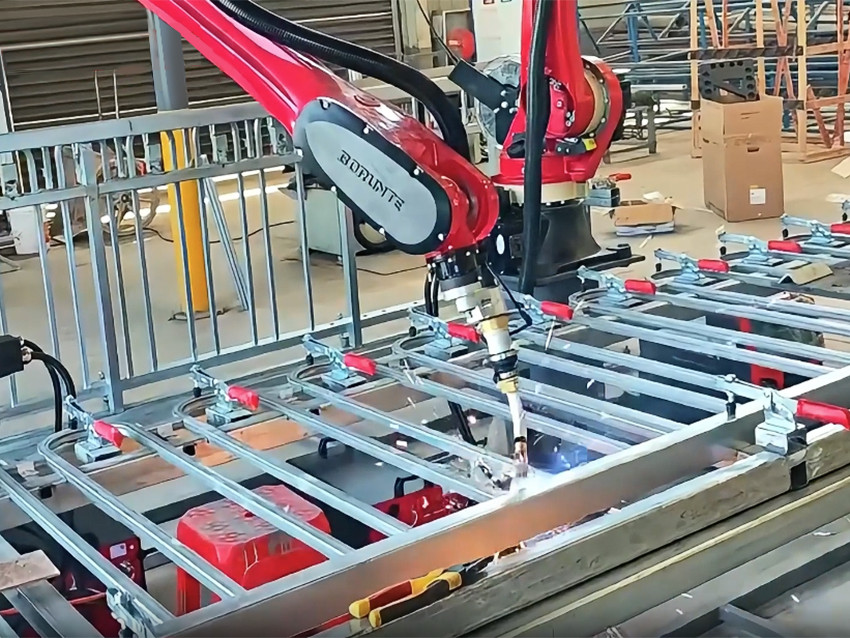
In repetitive processes such as welding, assembly, material handling, and loading/unloading, industrial robots maintain consistent motion precision and production rhythm.
After three years, factory managers often observe:
Reduced variation between shifts.
Dramatically more consistent product quality.
Easier and more predictable production planning.
ase Study – Furniture Manufacturing Spray Line:
Initial output: ~480 units/shift, ±5% variation between teams;
After three years: 490–492 units/shift, quality rate improved from 96% to 99%;
Rework rate decreased by ~15%.
IFR reports that long-term industrial robot operation can reduce defect rates in key processes by 10–15%.
This stability extends beyond efficiency, lowering rework, waste, and unplanned downtime, and it represents value that short-term investment cannot reveal.
2. More Controllable Resource Use and Energy Consumption
Industrial robots long-term operation also improves resource and energy management. Industrial robots achieve:
More efficient raw material use.
Stabilized energy consumption.
Reduced waste due to human error.
Case Study – Injection Molding Factory:
Raw material waste reduced from 4.2% to 2.1%;
Electricity consumption decreased by ~8%;
Material usage precision improved, minimizing production fluctuations.
These improvements support sustainable manufacturing goals and align with ISO 14001 Environmental Management Standards.
3. Workforce and Skill Structure Optimization
As robots take over hazardous or repetitive tasks, workers gradually shift into roles focused on process monitoring, equipment maintenance, and process optimization. After three years of operation:
Frontline operational pressure decreases.
Employee skill levels improve.
Turnover rates for high‑intensity and high‑risk positions decline.
These long‑term effects not only improve the working environment but also make it easier for companies to retain core operational and management talent.
Case Study – Automotive Component Welding Line:
10 operators originally performing 24-hour welding tasks.
After robot adoption, 5 operators focused on monitoring and optimization.
Error rate dropped by 60%, employee satisfaction and retention increased.
Long-term, this human-robot collaboration enhances workforce value while maintaining production efficiency.
4. Flexibility and Adaptability of Systems
Over a three‑year period, production requirements and product processes usually change.
Robot systems with flexible programming and modular end‑effectors can adapt to these changes by modifying programs and optimizing process parameters, rather than being forced into idleness.
For manufacturing enterprises, flexible systems are key to ensuring long‑term return on investment and sustainable equipment utilization.
End
Three years of continuous industrial robot operation reveals benefits far beyond short-term efficiency: production stability, resource control, workforce optimization, and system flexibility.
Understanding these changes helps manufacturers make strategic, sustainable decisions.
FAQ
Q1: How Long Does It Take For Industrial Robots To Deliver Stable Production Benefits?
A:
Most factories begin to see measurable stability improvements within the first 12–18 months. However, according to long-term observations, the most significant gains in production consistency, defect reduction, and planning accuracy typically appear after three years of continuous operation.
Q2: Do Industrial Robots Increase Maintenance Complexity Over Long-Term Operation?
A:
Not necessarily. When industrial robots are properly integrated and maintained, long-term operation often results in more predictable maintenance cycles, reduced emergency downtime, and clearer spare-parts planning compared to manual-intensive production lines.
Q3: How Do Industrial Robots Support Sustainable Manufacturing Goals Over Time?
A:
Industrial robots help stabilize energy consumption, reduce material waste caused by human error, and enable precise process control. Over several years, these improvements support lower unit energy usage, reduced scrap rates, and more consistent resource planning, aligning with sustainable manufacturing objectives.
Q4: Is System Flexibility Still Valuable After Several Years Of Robot Operation?
A:
Yes. Flexible programming and modular end-effectors allow industrial robots to adapt to new products and process changes. Factories using flexible systems report shorter changeover times and higher long-term equipment utilization, even after multiple years of operation.