Automation vs. Robotics: Key Differences, Types, and How to Choose the Right Solution for Your Factory
Robotics is a subset of automation, not a synonym for it. Confusing automation with robotics is one of the costliest mistakes during factory equipment upgrades. We break down their key distinctions, introduce common automation and robot types, and deliver actionable advice to help you select the right solution for your production workflow.
Automation vs. Robotics
Confusing automation with robotics is one of the most common—and costly—mistakes in equipment selection. Before diving into definitions, here's a quick side-by-side to frame what actually separates the two.
| Automation | Robotics | |
| Definition | A system that executes a predefined process without manual intervention. | A physical machine that can sense, move, and manipulate objects in its environment. |
| Requires Physical Hardware | No — can be purely software/process-based | Yes — always involves a physical unit |
| Reprogrammable | Often limited to its original process logic | Highly reprogrammable across different tasks |
| Typical Use Case | Fixed, repetitive workflows (e.g., conveyor sorting, PLC-controlled lines) | Tasks requiring physical manipulation or mobility (e.g., pick-and-place, welding, assembly) |
Relative Cost Range | Low–Moderate | Moderate–High |
What Is Automation?
Automation is technology that carries out a repetitive task with little to no human intervention. Think of a home thermostat: once set, it keeps adjusting the temperature on its own, without anyone touching a dial. Industrial automation works on the same principle, just at a larger scale.
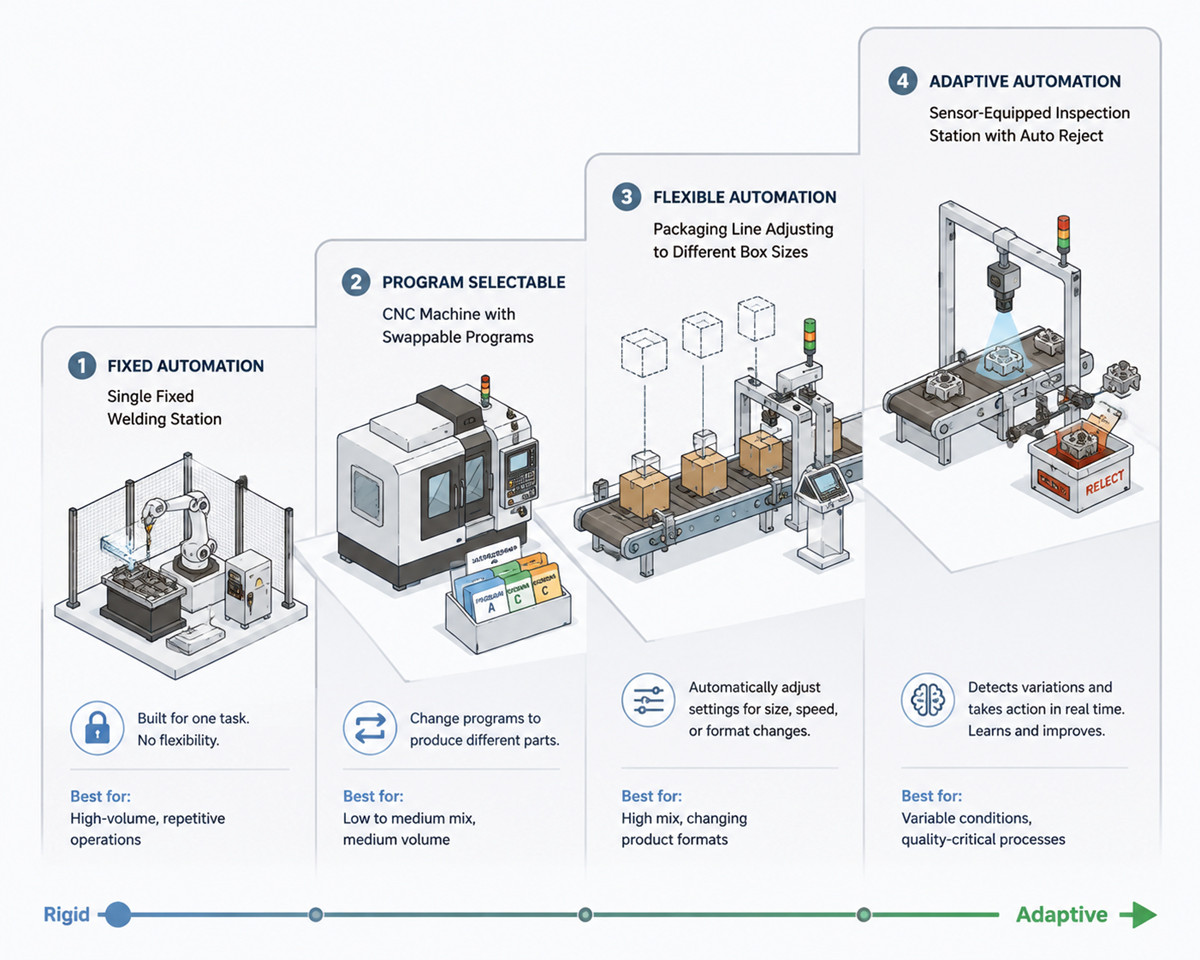
But automation isn't one thing—it exists on a spectrum, from rigid mechanical systems to software that never touches a physical object at all.
Types of Automation
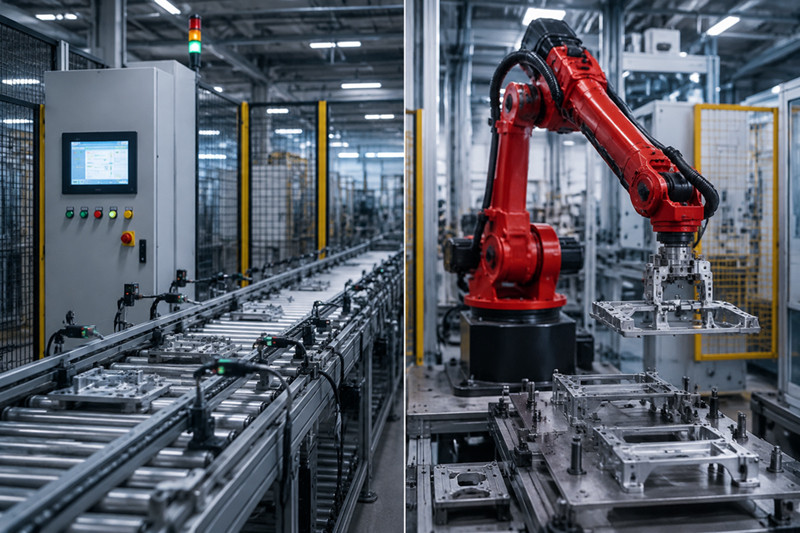
Fixed automation runs a single, unchanging sequence—think of the welding arms on an automotive body line, built to perform the exact same weld on the exact same part, thousands of times a day.
Programmable automation can switch between predefined routines, like a CNC machine that's reloaded with a new program to cut a different part profile.
Flexible automation goes a step further, adjusting on the fly—for example, a packaging line that automatically reconfigures itself to handle different box sizes without manual retooling.
Intelligent automation layers in sensors and decision logic, such as a quality-control system that inspects parts on a line and automatically rejects the ones that don't meet spec.
As these systems pick up more sensing and decision-making capability, the line between "automation" and "robotics" starts to blur—something we'll come back to shortly.
Software Automation & RPA
Not all automation is mechanical, though. Software automation, often built with RPA (Robotic Process Automation) tools, handles digital tasks instead of physical ones—for example, automatically pulling data from incoming invoices and entering it into an accounting system, no human keystrokes required. This is still automation, just without any hardware in the loop. Unlike a robotic arm, RPA never touches a physical object—it only interacts with digital systems and interfaces.
What Is Robotics?
Robotics, by contrast, almost always involves a physical body—a system built to sense its surroundings, move, and manipulate objects in the real world. Where automation can live entirely in software, robotics needs something with arms, wheels, or actuators to actually interact with the physical environment.
Types of Robots
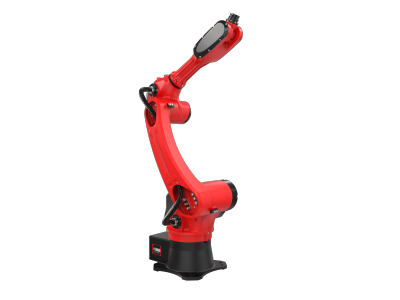
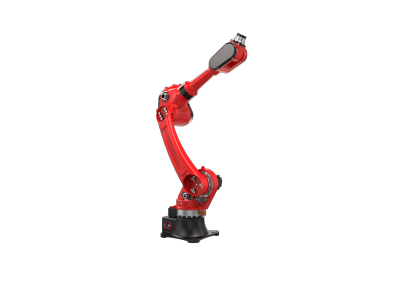
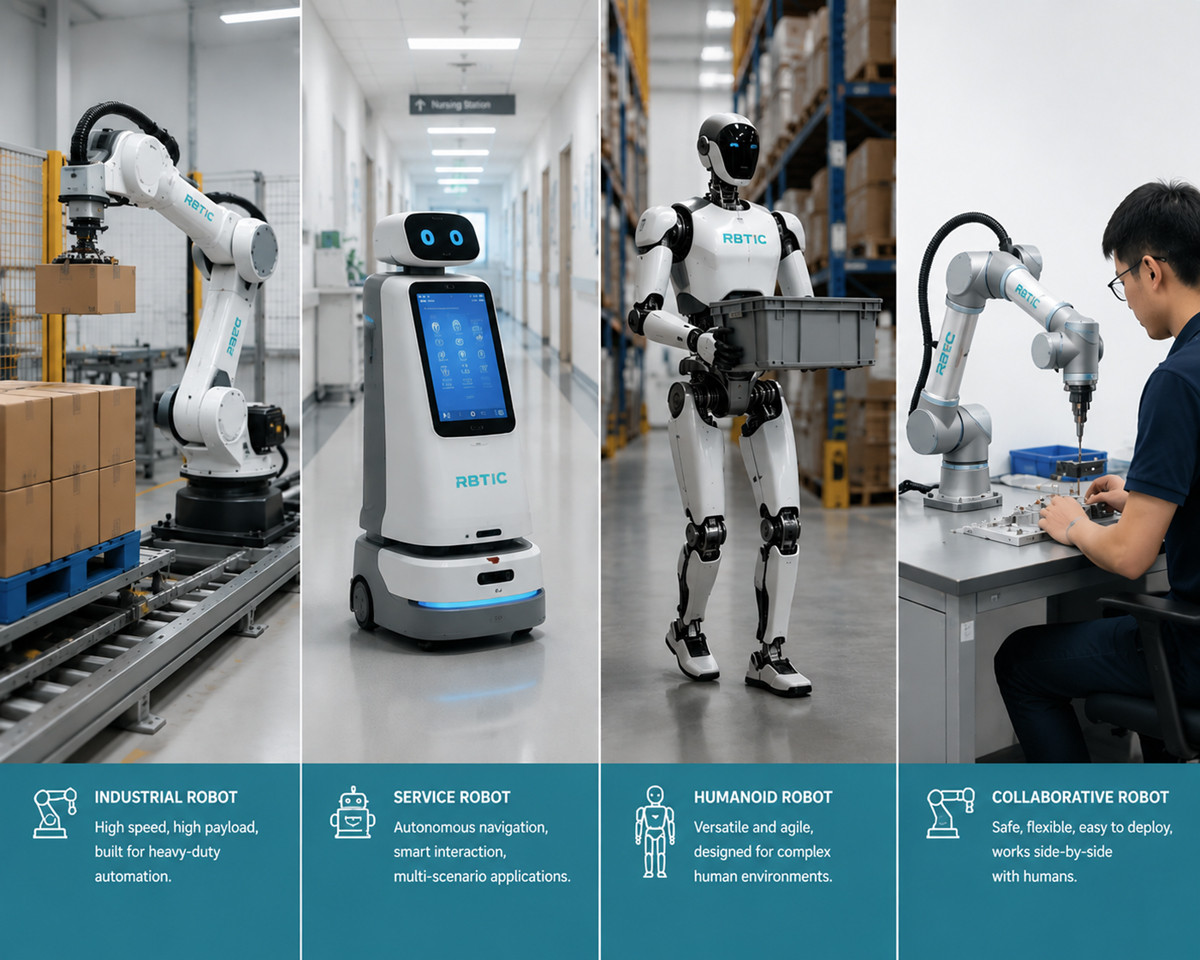
Industrial robots are the fixed or rail-mounted arms found on factory floors, handling tasks like die-casting or palletizing at high speed and repeatability.
Service robots operate outside manufacturing altogether—think of the delivery robots navigating hospital corridors to shuttle supplies between departments.
Humanoid robots are built to move and manipulate in ways that mimic human form factor, and are increasingly being tested in warehouse and logistics environments where they can use existing human-scale infrastructure.
Collaborative robots (cobots) are designed to work safely alongside people—for example, a cobot arm mounted next to a worker on an assembly line, handling repetitive fastening while the human handles inspection. Cobots and industrial robots are often confused, but the real distinction is safety design: cobots are built with sensors and force limits that let them operate in close proximity to people, while traditional industrial robots typically require caged-off work zones.
What Makes a Robot "Smart"
Not every robot on this list operates at the same level of autonomy. What separates a basic robot from a "smart" one comes down to three capabilities. Perception is the ability to sense the environment—for example, using a vision system to identify a part's orientation before attempting to grasp it. Decision-making is the ability to choose a course of action based on that input, such as planning a path around an unexpected obstacle rather than following a fixed route. Learning is the ability to improve performance based on feedback—for example, adjusting grip force after repeated attempts on a part with inconsistent tolerances. The more fully a robot combines these three capabilities, the closer it gets to operating like an autonomous AI agent.
Robotics vs. Automation: The Core Differences Explained
Flexibility & Reprogrammability
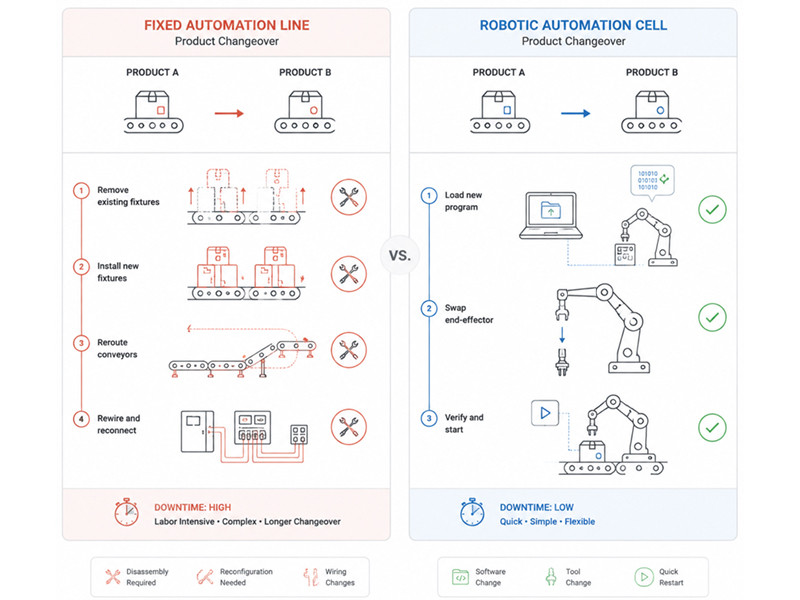
The clearest sign of this difference shows up when a product line changes. A fixed automation system built around one product often needs physical rework—new fixtures, rerouted conveyors, sometimes rewired controls—before it can handle a different part. A reprogrammable robotic arm, by contrast, can often be retasked by loading a new program and swapping an end-effector, with no structural changes to the line itself. That gap in what it takes to pivot is the real substance behind "flexibility," not just a label. It's also why many manufacturers evaluating an upgrade end up weighing programmable automation against collaborative robots side by side.
Physical Hardware vs. Software
This is the sharpest dividing line between the two. Robotics almost always involves physical hardware—sensors, actuators, some kind of body that acts on the world. Automation doesn't have that requirement: it can run entirely in software, as with RPA, or it can involve hardware, as with a PLC-controlled production line. Put differently, automation is the broader category, and robotics is the slice of it that necessarily takes physical form and typically carries some capacity to sense or act on its own. Every robot is a form of automation, but not everything that qualifies as automation is a robot.
Cost & Deployment Complexity
That hardware requirement is also where cost and complexity start to diverge. A software automation deployment mostly involves configuration and integration with existing digital systems. Robotics deployment adds layers that automation-only projects don't usually face: physical integration into a workspace, safety certification, task-specific programming or training, and ongoing mechanical maintenance. Industry reports on deployment timelines consistently point to integration and safety compliance as the main sources of added lead time for robotics, though the exact scope varies by application. That's part of why many companies start with simpler automation and only move to robotics once a clear, recurring physical task justifies the added complexity.
Automation and Robotics in 2026
AI Agents and Intelligent Automation
The clearest sign that the automation/robotics boundary is shifting has nothing to do with hardware at all. AI agents—software systems capable of deciding their own next step, calling tools, and working through multi-stage tasks without a human specifying each one—are now doing something that used to be the defining trait of a "smart robot": combining perception, decision-making, and learning, the same three capabilities described earlier. The difference is that an AI agent still has no physical form. It never picks up a part or moves through a workspace. But in terms of autonomy, it has caught up to—and in some cases surpassed—what earlier fell under "intelligent automation."
Consider a concrete case: an AI agent monitoring supply chain data, flagging an unusual delay pattern from a supplier, and automatically adjusting a purchase order schedule—all without a person reviewing each step, and without any physical hardware involved anywhere in the process. Under the traditional framework, that's automation, full stop, because there's no physical actuator in the loop. But the reasoning behind that decision—noticing a pattern, evaluating options, choosing an action—is exactly the kind of behavior that used to be used to distinguish a "smart robot" from a simple machine. The old shorthand ("automation follows rules, robots make decisions in the physical world") no longer holds cleanly, because a growing share of decision-making has moved into software that never touches hardware at all.
This matters practically, not just conceptually: it means the question "is this automation or robotics?" is no longer answered by asking "how smart is it?"—smart software with no body is now common. The only question that still reliably separates the two categories is the one from earlier in this article: does it act on the physical world, or not.
Humanoid Robots and General-Purpose Automation
The mirror-image shift is happening on the hardware side. A traditional industrial robot—even a reprogrammable one—is still built around a narrow task envelope: an arm designed for welding is a poor fit for bin-picking, and retooling it for a different job usually means new end-effectors, new fixtures, sometimes a different robot entirely. A humanoid robot breaks that logic. The same hardware platform—two arms, a torso, general-purpose grippers—can, in principle, be retrained for materials handling one month and light assembly the next, without a hardware swap. That's a fundamentally different relationship between hardware and task than anything covered under "types of robots" earlier: it's not a machine built for a task, it's a machine built for a category of tasks, with the specific task determined by training rather than design.
That's the real significance of humanoid robots in this context—not the human-like shape itself, but what the shape enables: a single physical platform aiming for the same generality that software automation already has in the digital world. Put the two trends together—AI agents pushing software automation toward autonomous decision-making, and humanoid robots pushing hardware toward general-purpose task flexibility—and they're converging from opposite ends toward the same middle ground. Automation is picking up the traits that used to define robotics (autonomy, decision-making); robotics is picking up the traits that used to define flexible automation (broad task coverage from a single system, not a purpose-built one). The comparison table at the top of this article draws a line between the two categories that still holds today—but it's worth remembering that line is being redrawn in real time, and the deciding factor going forward may be less "automation vs. robotics" and more "how general-purpose is this system, regardless of whether it has a body."
How to Decide
By now the differences are clear — the harder question is what to actually do with them. Here's a practical way to sort your own situation.
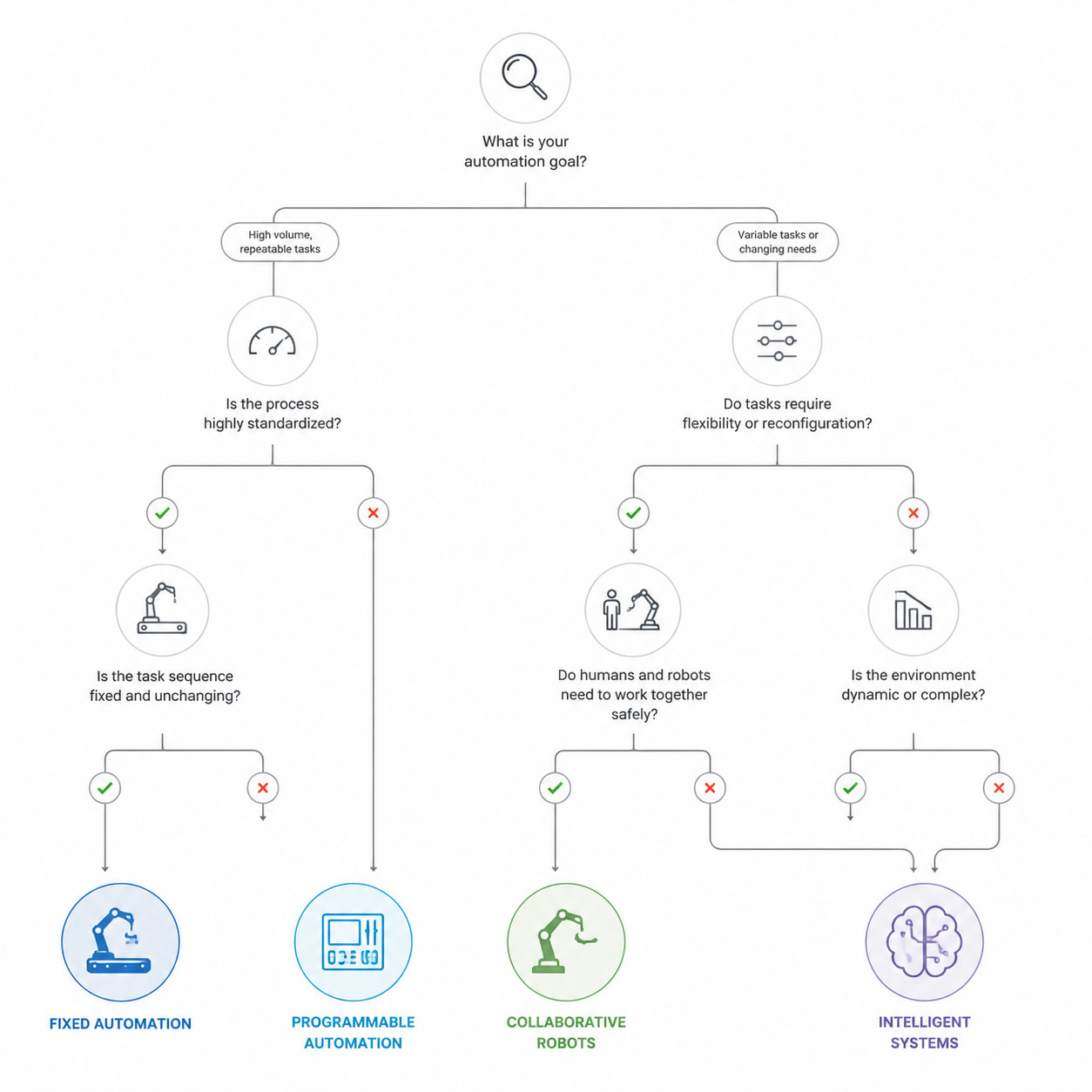
Is the task highly repetitive and unlikely to change? If yes, that points toward fixed automation — the setup cost is justified precisely because you won't be reconfiguring it often. If the task or product mix shifts regularly, lean toward flexible automation or collaborative robots instead, since retooling cost becomes the deciding factor.
How often does the line need to change over for a new product or task? Frequent changeovers favor programmable automation or a reprogrammable robot arm — anything requiring physical rework every time a spec changes will bottleneck you fast.
What's the budget reality? Software automation and simple fixed automation sit at the lower end. Robotics — especially anything requiring integration, safety certification, and training — sits at the moderate-to-high end. If budget is tight and the task is stable, automation-only is usually the more defensible first step.
Are there space, safety, or proximity constraints? If people need to work directly alongside the system, that pushes you toward collaborative robots specifically, not industrial robots — the safety design difference covered earlier isn't optional in that context.
Does the task require sensing or in-the-moment decision-making? If the system needs to identify variation (part orientation, defect detection, changing conditions) and adjust accordingly, you're in intelligent automation or smart robotics territory, not a fixed or purely mechanical setup.
Most real-world operations don't end up choosing one category outright — a stable core process often runs on straightforward automation, while the variable, physical, or safety-sensitive parts of the same line run on robotics. The two are frequently deployed together rather than picked as an either/or.
If you're still weighing which combination fits your specific line, that's exactly the kind of question worth walking through with someone who can look at your actual layout and volume — not just a general checklist.
Conclusion
If the answers point to a repeatable, rule-based task with a stable input, you're looking at an automation problem, and buying hardware will only move the cost, not the constraint. If the task requires physical manipulation in a space that changes, robotics earns its price tag — but budget for the integration work, not just the machine.
One caveat worth carrying into 2026: the line between the two is genuinely blurring. AI-driven perception and control mean a growing share of systems are both — software logic that happens to have arms. That doesn't make the distinction useless; it makes it a question about where the intelligence sits rather than whether there's a robot in the room. Ask which layer you're actually buying, and the vendor's category label stops mattering.
If you're weighing a specific process and the answer still isn't obvious, that's usually a sign the process needs mapping before it needs equipment.